







The English language has many words that can describe strength, power, influence, or effectiveness, but some words are more flexible than others. Potent is one of them. You may see it in a dictionary, a medicine label, a video game, a product name, a sentence, or even the title of a quest. Although the basic idea remains connected to power or strength, its exact meaning can change depending on the situation.
In simple English, potent describes something that has a strong effect, great power, considerable influence, or noticeable effectiveness. A medicine can be described this way when it produces a strong effect in a relatively small amount. An argument can also be called potent when it is especially convincing or impactful. Similarly, a person, organization, or force may be described with this word when it has significant influence.
Because the word appears in so many different contexts, people often search for its definition, meaning, synonyms, pronunciation, examples, and uses. It also appears in names connected with gaming, beauty, supplements, entertainment, and popular culture. This guide explains the word from its basic English meaning to some of the more unusual places where you may encounter it.
Quick Facts About the Word
| Word | Potent |
| Part of speech | Adjective |
| Basic meaning | Powerful, effective, or having a strong effect |
| Common use | Describing substances, people, arguments, ideas, and forces |
| Origin | From Latin roots associated with power and ability |
| Common synonyms | Strong, powerful, effective, influential |
| Opposite ideas | Weak, ineffective, powerless |
| Example | The medicine had a strong effect. |
Potent Definition and Different Uses
A dictionary-style potent definition generally centers on great power, influence, or effectiveness. However, understanding the context makes the definition much clearer.
Physical or Chemical Strength
In scientific, medical, and everyday product descriptions, the word can refer to something that has a powerful physical or chemical effect. A concentrated substance may be described this way because it works strongly even when only a relatively small amount is involved.
For example, a strong fragrance may be described as potent because its scent quickly fills a room. A concentrated cleaning product may also be described in similar language. In medicine, the term can describe a drug or treatment that has a strong biological effect, although medical potency and effectiveness are not exactly the same thing.
Power and Influence
The word can also describe people, organizations, countries, or forces that possess considerable influence. In this context, it is closer to “powerful” or “influential.”
A company that strongly affects an industry may be described as a potent force in its market. Likewise, a military or political organization can be described this way when discussing its influence or capabilities.
Emotional or Intellectual Impact
Another interesting use involves ideas, memories, images, arguments, and experiences. Something does not need physical power to have a strong effect.
A childhood memory can be a powerful reminder of the past. A lawyer may present a potent argument that strongly influences an audience. Similarly, a memorable photograph can become a powerful symbol of an important historical event.
In these examples, the word describes impact rather than physical strength.
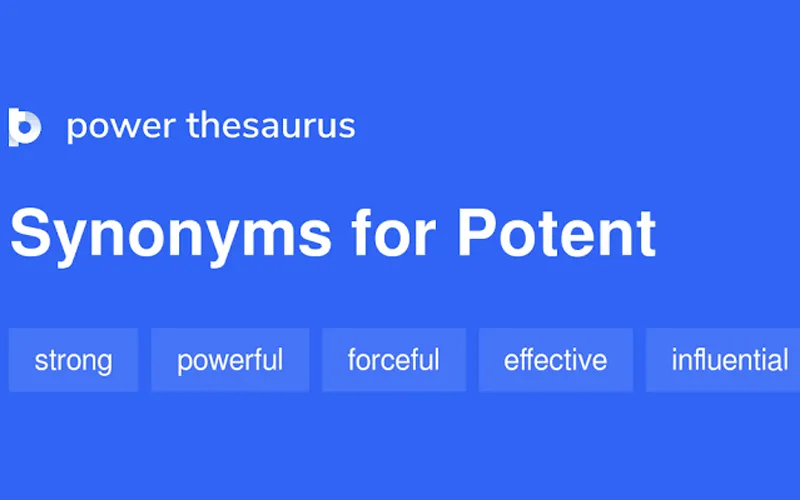
Potent Synonym: What Words Can Replace It?
The best potent synonym depends on the context. There is no single replacement that works perfectly in every sentence because the word has several meanings.
“Strong” is probably the most common alternative. You can use it when talking about drinks, smells, substances, medicines, or physical effects. “Powerful” is another close choice and works especially well when discussing forces, people, emotions, or ideas.
“Effective” is useful when the emphasis is on producing a desired result rather than simply possessing strength. “Influential” works better when the subject is a person, organization, or idea that affects other people. “Compelling” can replace it when describing an argument, explanation, or piece of evidence that has a powerful persuasive effect.
“Forceful” is another possibility, especially for speech, writing, or arguments. “Concentrated” is more appropriate when the subject is a substance containing a high amount of an active ingredient.
It is worth remembering that similar words may not work naturally in every context. Choosing the right word requires looking at what kind of strength the original sentence is trying to communicate.
How to Use Potent in a Sentence
Seeing a word used in different sentences can make its meaning and everyday usage much easier to understand.The word can fit naturally into many types of sentences.
A doctor might describe a particular medicine as highly potent because it produces a strong effect. When discussing food, someone might say that a sauce has an intense flavor. In business writing, a company can be described as a powerful competitor when it has considerable influence in its market.
It can also be used for emotions and memories. For example, someone might say that an old song is a potent reminder of childhood. Here, the word does not suggest physical power. Instead, it describes the emotional effect created by the song.
A persuasive argument can also be described as potent. In this case, the meaning is close to compelling or forceful. These different examples show why context is so important when learning vocabulary.
Potent Robe in Baldur’s Gate 3
The word has a completely different role when it appears in gaming. One well-known example is the Potent Robe in Baldur’s Gate 3. Here, it is the name of a specific clothing item rather than an ordinary description.
The item is particularly associated with characters that rely on Charisma-based abilities. Its special effects can improve the performance of cantrips and provide additional survivability, which is why it has become a popular topic among players building Warlock and other spellcasting characters.
Obtaining the item is connected to the Tiefling rescue storyline. Players need to keep Alfira alive and successfully rescue the Tiefling prisoners at Moonrise Towers before progressing beyond an important point in Act 2. The timing matters because progressing too far can prevent the reward from becoming available.
The item also has a special interaction with Dark Urge playthroughs. Players familiar with the game’s mechanics have discovered ways to keep Alfira alive by manipulating the events surrounding the Dark Urge camp sequence. This allows the later storyline involving the robe to remain possible.
The gaming example is a good reminder that a vocabulary word can become part of a proper name. In this case, “potent” communicates the idea of power or effectiveness while “robe” identifies the type of equipment.
Super Nature Potent Aloe Shampoo
The word also appears in the beauty and personal-care industry. Super Nature Potent Aloe Shampoo uses the term as part of its product name, where it is intended to communicate strength or concentrated care.
The product is marketed around aloe-based moisturizing and gentle cleansing. Descriptions of the formula commonly emphasize ingredients and characteristics such as aloe, mild cleansing agents, and a sulfate-free formulation. Consumers interested in hair products may encounter the name while searching for moisturizing shampoos or products designed for treated hair.
In product naming, words associated with strength are often chosen because they quickly communicate an intended benefit. However, the presence of a word such as “potent” in a product name does not by itself prove that the product is more effective than every alternative. The actual formula, ingredients, testing, and individual hair needs are more useful factors when evaluating a product.
A More Potent Foe in World of Warcraft
Gamers can also encounter the expression A More Potent Foe in World of Warcraft. In this context, it is the title of a quest associated with the game’s story content.
The phrase itself is easy to understand once the ordinary meaning of the adjective is clear. “A more potent foe” simply means an opponent that represents a greater level of power, influence, or threat.
This is an example of how adjectives can make game titles more descriptive. Instead of simply saying that a character has another enemy, the phrase suggests that the new opponent is considerably more powerful or significant.
A Most Potent Brew in Dungeons & Dragons
Another interesting use is A Most Potent Brew, a short adventure created for Dungeons & Dragons. The adventure is designed as an approachable scenario for beginning players and groups looking for a relatively compact fantasy adventure.
The title uses playful language. “A most potent brew” suggests an unusually strong or remarkable drink, which fits the adventure’s brewery-related setting. The scenario begins with what appears to be a straightforward problem involving creatures in a cellar but develops into a small dungeon adventure with puzzles, exploration, and combat.
This is a good example of how the word can be used creatively. It does not necessarily mean that the drink is scientifically concentrated. Instead, it adds humor and character to the title.
What Does “Potent Potables” Mean?
Potent potables is another famous phrase that combines two words. “Potable” refers to something that is suitable or safe to drink, while “potent” suggests strength. Together, the phrase can be understood as “strong drinks.”
The expression became especially recognizable through the television quiz show Jeopardy!, where “Potent Potables” has been used as a category associated with alcoholic beverages and drink-related trivia.
The phrase works because of its playful alliteration. Both words begin with the same sound, making the expression memorable. It also demonstrates how an ordinary adjective can become part of a humorous or culturally recognizable phrase.
Potent and High-Potency Cannabis Terms
The word is also frequently used when people discuss cannabis products, especially those with high THC concentrations. Searches for products described as potent generally focus on their strength or THC content, while factors such as formulation and individual response can also affect the overall experience.
However, potency should not be treated as the same thing as overall quality or personal suitability. A higher THC concentration can produce stronger effects, but the experience can vary substantially between individuals. Factors such as tolerance, product type, cannabinoid composition, consumption method, and individual response can all influence the experience.
For edible products in particular, effects can take longer to appear than people expect and may last considerably longer. That makes high-potency products more important to approach cautiously. Legal requirements and product availability also vary significantly by location.
When discussing cannabis scientifically, it is also useful to distinguish THC percentage from the broader concept of potency. Laboratory results, serving size, product consistency, and labeling accuracy can all matter when interpreting a product’s strength.
Most Potent Indica Strains
The phrase most potent indica strains is commonly used online to describe cannabis varieties that are reported to contain relatively high THC levels or produce strong effects associated with relaxation and sedation.
Names such as Godfather OG, GMO Cookies, Ice Cream Cake, Death Bubba, and Granddaddy Purple are frequently mentioned in discussions about high-THC indica or indica-dominant varieties. However, reported THC levels can vary considerably between growers, harvests, laboratories, and individual samples.
It is therefore better to treat strain names and advertised percentages as descriptions rather than guarantees. A particular strain can have different laboratory results depending on the specific product being tested. In addition, the traditional “indica versus sativa” distinction does not completely explain the effects of modern cannabis varieties, many of which are hybrids.
For anyone researching cannabis, the term “potent” should therefore be understood as a reference to strength or concentration rather than a universal measurement of quality.
Peter Thomas Roth Potent-C Power Eye Cream
The word appears in skincare as well. Peter Thomas Roth Potent-C Power Eye Cream is a vitamin-C-focused eye treatment marketed for concerns such as the appearance of dark circles, puffiness, and signs of aging.
The product’s name uses “potent” as a marketing term to communicate a concentrated or powerful skincare approach. Its formula features a vitamin C derivative along with other ingredients used in antioxidant and moisturizing skincare.
This is another useful example of context. When someone sees the word on a cosmetic product, it does not necessarily carry the strict scientific meaning that it might have in pharmacology. Instead, it can be part of branding designed to communicate intensity or advanced formulation.
PERQUE Potent C Guard
Another product containing the word is PERQUE Potent C Guard, a vitamin C supplement formulated around buffered vitamin C. The product is marketed as a gentler form of vitamin C compared with acidic ascorbic acid formulations.
Buffered vitamin C generally refers to vitamin C combined with mineral compounds intended to reduce its acidity. The specific formulation and serving information should always be checked on the manufacturer’s current label because supplement formulas and recommendations can change.
Again, the word in the product name reflects the idea of strength or concentrated nutritional support. It does not mean that every person will experience the same result.
Prefix With Present or Potent
One common vocabulary and crossword question asks for the prefix with present or potent. The answer is “omni.”
Adding “omni-” to “present” produces “omnipresent,” meaning present everywhere. The same prefix can be combined with “potent” to form “omnipotent,” a word traditionally used to describe unlimited or all-encompassing power.
The prefix comes from Latin and carries the idea of “all.” This makes both words logical combinations because omnipresence refers to being everywhere, while omnipotence refers to having unlimited power.
The connection is especially useful for vocabulary learners because knowing one word can help explain another. Understanding common prefixes can make unfamiliar English words easier to recognize and remember.
Potent Medicine in Persona 3 Reload
Gaming provides yet another example through Potent Medicine in Persona 3 Reload. In the game, it is connected with one of Elizabeth’s requests and is obtained through the Nurse’s Office at Gekkoukan High School.
The quest asks the player to obtain the medicine and return it to Elizabeth. The unusual circumstances surrounding the item make the request memorable, especially because the game often mixes serious supernatural storytelling with humorous everyday situations.
Here, “potent” once again means something powerful or unusually effective, but it is primarily being used as part of the item’s name.
Potent vs. Strong: Are They the Same?
Although “potent” and “strong” are often interchangeable, they are not identical in every situation.
“Strong” is much more general. You can use it for physical strength, flavor, smell, emotions, relationships, arguments, or even weather. “Potent” tends to emphasize the ability to produce a significant effect.
For example, “a strong person” usually refers to physical strength, while “a potent argument” emphasizes persuasive impact. Similarly, “a strong smell” and “a potent smell” can have similar meanings, but the second expression can sound more formal or intense.
The choice depends on tone as well as meaning. Everyday conversation often favors “strong,” while formal writing, scientific discussion, product descriptions, and literary language may use “potent.”
Common Mistakes When Using the Word
One common mistake is assuming that the word always means “extremely strong” in a physical sense. As the examples above show, it can also describe influence, effectiveness, emotional impact, and persuasive power.
Another mistake is using every synonym in exactly the same way. “Concentrated,” “powerful,” “effective,” “influential,” and “compelling” overlap with the word but carry different shades of meaning.
It is also important not to assume that something described as potent is automatically better. In medicine, cosmetics, supplements, and other products, greater strength may not always be appropriate for every person. The meaning of the word describes intensity or effect; it does not automatically provide a quality judgment.
Frequently Asked Questions
1. What does potent mean in simple English?
It describes something that has considerable power or produces a noticeable effect. The meaning can vary according to the situation.
2. What is a good synonym for potent?
Useful alternatives include strong, powerful, effective, influential, forceful, and compelling. The right option depends on the sentence.
3. How can I use the word in a sentence?
For example, you can say, “The medicine had a potent effect.” It may also describe an argument, memory, smell, or emotion.
4. Is potent the same as strong?
Not always. “Strong” is a broader everyday term, while the other word often focuses on the ability to create a significant effect.
5. What does potent mean in medicine?
It generally refers to something capable of producing a strong biological effect. Potency should not automatically be confused with effectiveness or safety.
6. What is the opposite of potent?
Depending on the context, possible opposites include weak, mild, ineffective, powerless, or insignificant.
7. What does omnipotent mean?
It means having unlimited power. The prefix “omni-” means all, while the remaining part relates to power or ability.
8. Can potent describe an idea or emotion?
Yes. The word can describe an idea, memory, speech, image, or emotion when it creates a particularly strong intellectual or emotional impact.
Conclusion
The word potent is useful because it can describe many forms of strength. It can refer to a powerful substance, an influential person, a convincing argument, an emotional memory, a game item, or a product name. Its central idea remains consistent: something has a significant ability to create an effect.
Understanding context is the key to using the word naturally. In everyday English, “strong” is often the simplest synonym. In formal writing, “powerful,” “effective,” “influential,” “forceful,” or “compelling” may provide a more precise alternative depending on what you are describing.
From dictionary definitions to expressions such as “potent potables,” the word appears in many areas of modern language and popular culture, including gaming titles like Baldur’s Gate 3 and Persona 3 Reload. Learning these different uses makes the vocabulary easier to understand and helps you choose the right word when writing your own sentences.
For more interesting stories and biographies, visit tend zore to explore more.