





The rivalry between Ireland and England is one of the most interesting sporting and cultural rivalries in Europe. It becomes especially intense in rugby, cricket, and football, but the relationship between the two countries goes far beyond the playing field. Their shared history, geographical closeness, different political identities, and strong sporting traditions have created a rivalry that continues to attract huge attention.
For sports fans, the phrase Ireland vs England can mean several different things. Rugby supporters immediately think about the Six Nations, while cricket followers may remember Ireland’s famous limited-overs victories over England. Football fans also have plenty of memories from their meetings, including the recent UEFA Nations League games. Outside sport, people often search for comparisons involving education, private schools, national size, and the historical relationship between the two countries.
The latest major men’s rugby meeting produced one of the most memorable results in recent years. On February 21, 2026, Ireland defeated England 42-21 at Allianz Stadium, Twickenham, in the Men’s Six Nations. It was not simply another victory. Ireland recorded its highest points total against England at Twickenham and its biggest winning margin against England in London.
At the same time, women’s rugby and cricket have created their own storylines during 2026. England Women defeated Ireland Women 33-12 in the Women’s Six Nations, while the women’s cricket teams are meeting in a three-match ODI series in England in September. This makes the rivalry particularly active across different sports.
Quick Bio: Ireland vs England
| Category | Ireland | England |
| Country | Ireland | England |
| Capital | Dublin | London |
| Main Rugby Team | Ireland Men | England Men |
| Rugby Union | Six Nations | Six Nations |
| Cricket Status | ICC Full Member since 2017 | ICC Full Member since 1909 |
| Major Rugby Venue | Aviva Stadium | Allianz Stadium, Twickenham |
| Football Governing Body | Football Association of Ireland | The Football Association |
| Famous Rugby Rivalry | Six Nations and Millennium Trophy | Six Nations and Millennium Trophy |
| Geographic Position | Western Europe | Northwestern Europe |
| Sporting Strengths | Rugby, cricket, football | Rugby, cricket, football |
Why Is Ireland vs England Such a Big Rivalry?
The importance of this rivalry comes from more than competitive sport. Ireland and England are geographically close, but their national identities and sporting cultures are distinct. Whenever their national teams meet, there is usually an additional emotional layer because supporters understand the historical background between the two countries.
Rugby has perhaps produced the strongest modern sporting rivalry. Both nations are established Six Nations powers, and matches between them frequently have consequences for championship hopes, Triple Crown ambitions, and tournament momentum. Even when neither team can win the title, a victory over the other side carries enormous prestige.
The rivalry is also interesting because the balance has changed over different periods. England have historically enjoyed a strong overall record in men’s rugby, but Ireland have become one of the most consistent teams in world rugby during the professional era. Their tactical development, defensive organization, attacking structures, and depth have helped them compete with the world’s leading sides.
Cricket offers a different type of rivalry. England have a much longer history at the highest level, but Ireland have repeatedly demonstrated that they can challenge established teams in short-format cricket. Their famous victory over England at the 2022 Men’s T20 World Cup remains one of the best examples.
Football adds another dimension. England generally possess greater financial resources and a deeper pool of elite players, while Ireland’s national team has a proud history of producing determined performances against its larger neighbour.
Ireland vs England Rugby: The 2026 Six Nations Classic
The biggest recent chapter came on February 21, 2026, when Ireland travelled to Twickenham for their Round 3 Six Nations match against England. Few people expected the final score to be as one-sided as it became.
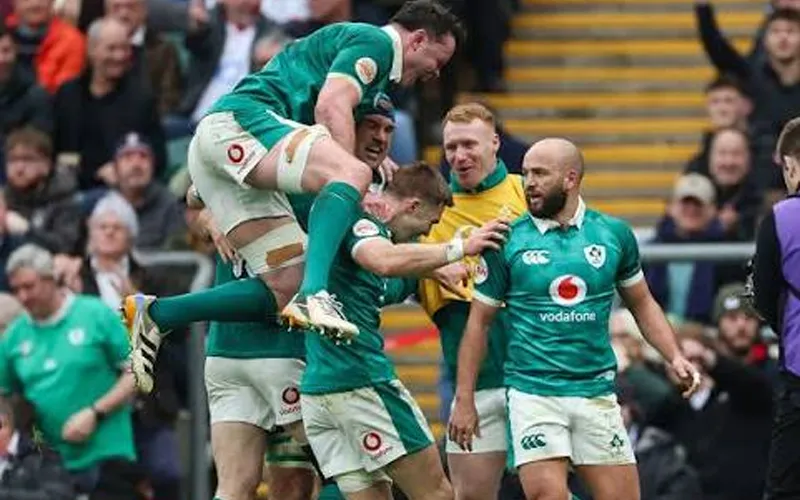
Ireland won 42-21, producing a powerful attacking display that overwhelmed England for long periods. The result was particularly significant because Twickenham has traditionally been a difficult venue for visiting teams. Ireland did not simply win; they controlled major portions of the match and scored at crucial moments.
Jack Crowley opened the scoring with a penalty in the ninth minute. Ireland then accelerated the game with a remarkable three-try burst. Jamison Gibson-Park, Robert Baloucoune, and Tommy O’Brien all crossed the line during an outstanding period of attacking pressure.
England eventually responded through Fraser Dingwall before half-time, but Ireland went into the break with a commanding 22-7 advantage. The Irish side had already created enough momentum to make a comeback difficult.
The second half continued in much the same direction. Dan Sheehan scored shortly after the interval while England were down to 14 players following Henry Pollock’s sin-bin. England then showed some fight when Ollie Lawrence scored, reducing the gap to 29-14.
However, Ireland remained composed. Jamie Osborne scored late in the match to effectively remove any remaining doubt about the result. Sam Underhill added a late try for England, but the final score remained 42-21.
The victory was particularly memorable for Jamison Gibson-Park, who was named Player of the Match. His ability to control the speed of Ireland’s attack was one of the major reasons the visitors were able to maintain pressure throughout the game.
Ireland vs England History in Rugby
The rugby rivalry dates back to the nineteenth century, with the first meeting taking place in 1875. Since then, the teams have played numerous international matches across different eras.
England have the stronger overall historical record, but Ireland’s modern success has significantly narrowed the competitive gap. The professional era has been particularly important because Ireland developed into a consistent championship contender rather than a team that occasionally produced major upsets.
The fixture also carries the Millennium Trophy, which adds another prize to an already important Six Nations contest. Ireland currently hold that trophy after their 2026 victory at Twickenham.
The rivalry is not only about statistics. For supporters, these matches represent national pride, history, and the desire to beat a familiar opponent. That is why even a match without championship implications can attract enormous interest.
Ireland vs England Rugby 2027: What Comes Next?
The next men’s Six Nations meeting is scheduled for Friday, February 5, 2027, at Dublin’s Aviva Stadium. The change of venue will be important because Ireland will have home advantage after producing their 2026 victory in London.
The previous result naturally gives Ireland confidence, but predicting another large win would be risky. International rugby can change quickly, and England have the resources, coaching expertise, and player quality to respond strongly.
The 2027 match could therefore feel very different. England will want to correct the problems exposed in 2026, while Ireland will try to prove that their Twickenham performance was part of a sustained advantage rather than a one-off result.
Ireland vs England Rugby Tickets
Interest in Ireland vs England rugby tickets is normally extremely high because the fixture combines two major Six Nations nations with a passionate supporter base. Tickets for a Dublin meeting can be particularly difficult to secure through ordinary public sales.
For the 2027 fixture at Aviva Stadium, supporters should focus on official rugby union channels, affiliated clubs, supporter memberships, and authorized travel providers. Because demand is high, unofficial resale platforms can carry additional risks, including inflated prices and invalid tickets.
Those searching for Ireland vs England tickets should therefore check official sources first. Travel packages can also be an option for overseas supporters because some authorized providers combine accommodation with match admission.
Ireland vs England Cricket: A Different Kind of Rivalry
Rugby may receive more attention, but cricket has also produced memorable meetings between these nations. England have a much longer history in international cricket, while Ireland became an ICC Full Member in 2017 and have steadily developed their international program.
The difference in experience has not stopped Ireland from competing strongly in limited-overs cricket. In fact, their ability to cause surprises is one of the reasons matches involving the two teams are so interesting.
The men’s teams last met in a bilateral T20I series in September 2025 in Malahide. England won the series 2-0. The first match saw England chase Ireland’s 196/3 by four wickets, while the second game was abandoned because of rain. England then won the third match by six wickets after restricting Ireland to 154/8.
This recent series is important context for anyone searching for Ireland vs England T20 information. Although the two sides have no men’s bilateral T20I scheduled during 2026 or 2027, their previous encounters remain part of a competitive short-format history.
The Famous 2022 T20 World Cup Upset
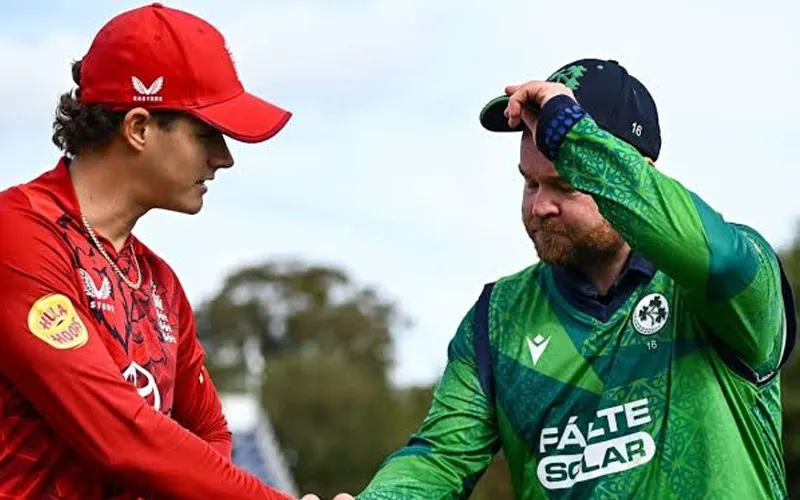
One of the most famous moments in modern Irish cricket came at the 2022 ICC Men’s T20 World Cup. Ireland defeated England by five runs under the Duckworth-Lewis-Stern method at the Melbourne Cricket Ground.
Andrew Balbirnie played a crucial role with a brilliant 62, helping Ireland establish a competitive total before rain affected the chase. England were unable to complete the required target and Ireland celebrated one of the biggest wins in their cricket history.
That result remains an important reminder that England’s greater cricketing depth does not guarantee victory. In T20 cricket, a few overs can completely change a match.
Ireland Women vs England Women in 2026
The women’s teams have created their own busy schedule during 2026. In the Women’s Six Nations, England defeated Ireland 33-12 on April 11 at Allianz Stadium.
England’s Red Roses entered that match with an extraordinary international record and continued their winning run with another strong performance. The result demonstrated the significant gap that still exists between the two sides in women’s rugby, although Ireland continue to invest in their development.
Cricket has provided a much more competitive setting. In September 2026, Ireland Women are touring England for a three-match ODI series. The first ODI is taking place on September 1 at Grace Road in Leicester.
Ireland posted 281/5 in their 50 overs, with Gaby Lewis scoring 69 and Amy Hunter making 62. The total gave Ireland a strong platform and showed that the visitors were capable of putting pressure on England’s bowling attack.
The second ODI is scheduled for September 3 in Derby, followed by the third match on September 6 at New Road in Worcester.
Ireland vs England Prediction: Who Has the Edge?
Any Ireland vs England prediction needs to identify the sport first because the balance between the teams changes considerably.
In men’s rugby, Ireland currently have a strong psychological advantage after their 42-21 victory in 2026. They also have the benefit of playing the next Six Nations meeting at home. That makes Ireland a logical favorite going into the 2027 encounter, although England have more than enough quality to produce a response.
In men’s cricket, England generally start as the stronger side because of their greater depth and experience, particularly in white-ball cricket. However, Ireland’s history of producing surprise results means they should never be dismissed.
Women’s cricket is more difficult to judge without considering the specific match conditions. England have greater depth and home advantage, but Ireland’s 281/5 in the first ODI of the September 2026 series demonstrated that they can put together competitive performances.
Football presents another situation. England possess greater depth and generally compete among the world’s strongest national teams. Ireland have historically been capable of making matches difficult, but England would normally be expected to enter as favorites.
Ireland vs England Football: Recent Meetings
The football rivalry has its own long history. England and the Republic of Ireland first met in the modern international era in the 1940s, and one of the most memorable early moments came in 1949 when Ireland defeated England 2-0 at Goodison Park.
More recently, the two teams met competitively in the 2024-25 UEFA Nations League. England won both matches.
In September 2024, England defeated Ireland 2-0 at the Aviva Stadium in Dublin. Declan Rice and Jack Grealish, both players with Irish connections, scored for England.
The return fixture at Wembley in November 2024 was much more one-sided. England won 5-0 after a scoreless first half. Ireland’s Liam Scales was sent off, and England took advantage during an impressive second-half performance.
The football rivalry therefore has a different competitive balance from rugby. England have generally had the stronger squad in recent years, while Ireland continue to develop a younger generation of players.
Ireland vs England Size: How Different Are They?
Searches for Ireland vs England size often refer to the geographical and population differences between the two countries.
England is considerably larger in both population and economic scale. It has a population of more than 50 million and contains major metropolitan areas such as London, Birmingham, Manchester, Liverpool, and Leeds.
The Republic of Ireland has a population of roughly five million and is geographically smaller. Dublin is by far its largest urban center, while Cork, Limerick, Galway, and Waterford are other important cities.
Despite this difference in scale, Ireland has developed a sporting culture that regularly allows its national teams to compete internationally. Rugby is perhaps the clearest example, where Ireland have become a major world power despite having a much smaller population than England.
Private Schools Ireland vs England Differences
The comparison between education systems is another reason people search for private schools Ireland vs England differences. Although both countries have fee-paying schools, their structures and financial relationships with the state are not identical.
In Ireland, fee-paying secondary schools operate within a system where the state plays a significant role in education funding. Many teachers’ salaries are supported by the government, while fee-paying schools may charge families for additional services, facilities, and other expenses.
England’s independent-school sector operates with greater financial independence from the state. Historically, some prestigious English institutions have been known as public schools, even though the term can be confusing to people outside the United Kingdom because these schools are actually independent and fee-paying.
This creates a major difference in the cost of education. English private education can be substantially more expensive, particularly at prestigious boarding schools. Ireland’s fee-paying schools can also be costly, but the financial model is different.
Private Schools in Ireland vs England Differences in Curriculum
Another important distinction concerns examinations and curriculum.
Irish secondary students generally follow the national education framework, including the Junior Cycle and Leaving Certificate systems. Even fee-paying schools operate within this broader national structure.
English independent schools have greater freedom to choose educational programs. Depending on the institution, students may study GCSEs, International GCSEs, A-Levels, or the International Baccalaureate.
This does not automatically mean one system is better than the other. The difference is more about educational structure, school autonomy, examinations, and the historical development of private education.
People researching private schools Ireland vs England difference should therefore look beyond tuition fees. Curriculum, boarding options, school size, university pathways, extracurricular activities, and the relationship between the school and government all matter.
Ireland vs England War: Understanding the History
The phrase Ireland vs England war can be misleading because there was not one single continuous war between modern Ireland and England. Instead, the relationship includes centuries of conquest, rebellion, political control, religious conflict, independence movements, and later diplomatic cooperation.
English involvement in Ireland dates back to the Anglo-Norman invasion in the twelfth century. Over subsequent centuries, English and later British governments expanded their political control over Ireland.
The Tudor period brought major changes, including Henry VIII’s declaration of the Kingdom of Ireland and efforts to strengthen English authority. Resistance continued through events such as the Nine Years’ War.
The seventeenth century brought further conflict, including the Cromwellian conquest and the Williamite War. Religious divisions became deeply connected to political power, land ownership, and control.
The 1798 Rebellion was another major uprising. Its failure was followed by the Act of Union, which brought the Irish Parliament into the Parliament of the United Kingdom.
Irish Independence and Partition
The early twentieth century transformed the relationship dramatically. The Easter Rising of 1916 became a major turning point in the Irish independence movement.
The Irish War of Independence from 1919 to 1921 eventually resulted in the Anglo-Irish Treaty. The agreement established the Irish Free State while six counties in the north remained part of the United Kingdom.
This partition created the political geography that exists today, with the Republic of Ireland as an independent state and Northern Ireland remaining part of the United Kingdom.
The later Troubles in Northern Ireland represented another long and painful period of conflict. Violence continued for decades before the Good Friday Agreement of 1998 established a new political framework.
Today, the relationship is fundamentally different from the conflicts of the past. Ireland and the United Kingdom maintain diplomatic, economic, family, cultural, and sporting connections, even though historical issues continue to influence public discussion.
Scotland vs Ireland vs England
When Scotland is added to the comparison, the picture becomes even more interesting because all three nations share deep sporting traditions.
In rugby, England, Ireland, and Scotland compete in the Six Nations and have separate historic trophies. Ireland and Scotland contest the Centenary Quaich, while England and Scotland compete for the Calcutta Cup.
The 2026 Six Nations provided another example of these interconnected rivalries. Ireland defeated both England and Scotland and secured the Triple Crown by beating the other three Home Nations: England, Scotland, and Wales.
Cricket is different. England and Ireland are both ICC Full Members, while Scotland remains an Associate Member. Scotland nevertheless has a strong limited-overs tradition and regularly competes against major cricketing nations.
Football also gives supporters another three-way comparison, although the competitive circumstances differ from rugby and cricket.
Key Players to Watch
For Ireland’s rugby team, Jamison Gibson-Park remains an important figure because of his ability to control tempo and organize attacks. His Player of the Match performance against England in 2026 showed exactly why he is so valuable.
Jack Crowley is another important player. His kicking accuracy can turn territorial pressure into points, while his ability to manage games gives Ireland another tactical advantage.
Players such as Dan Sheehan and Jamie Osborne also demonstrated their attacking importance during the 2026 victory. Ireland’s strength, however, comes from the depth of the squad rather than dependence on one star.
England have their own group of experienced players and emerging talents. Maro Itoje remains one of the most recognizable leaders in English rugby, while Ollie Lawrence demonstrated against Ireland that England can still produce dangerous attacking moments.
The key question for England is not whether they have talented players. They clearly do. The bigger issue is how effectively those players can work together against an Irish team that has developed a highly organized system.
Final Thoughts on Ireland vs England
The story of these two countries cannot be reduced to one sport or one result. Rugby has produced one of the strongest modern rivalries, cricket has delivered memorable surprises, and football has created its own fascinating history. Beyond sport, the relationship includes centuries of complicated political and social history.
The 2026 rugby meeting will remain one of the standout moments of the rivalry because Ireland produced a spectacular 42-21 victory at Twickenham. It showed the quality of Ireland’s attack, the importance of game management, and the growing confidence of a team that has become one of rugby’s leading nations.
England, however, remain too talented and experienced to write off. Their response in the next major meeting will be closely watched, particularly when they travel to Dublin for the 2027 Six Nations.
For cricket supporters, the women’s ODI series in September 2026 provides another immediate chapter. For football followers, the rivalry remains historically important even though England currently have the stronger squad on paper. And for people interested in education or history, comparisons involving private schools, national size, and the centuries-old relationship reveal why the connection between the two countries remains so complex.
Ultimately, Ireland vs England is a rivalry shaped by sport, history, identity, and geography. Whether the contest takes place on a rugby field, cricket ground, or football pitch, it carries a significance that goes well beyond the final score.
For more interesting stories and biographies, visit tend zore to explore more.